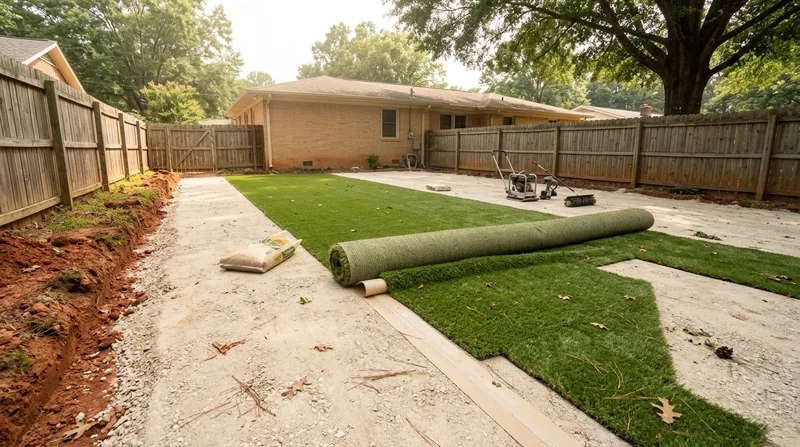




Residential artificial grass installation in Greenville transforms a yard that struggles with heat, shade, or dense red clay into a low-maintenance outdoor space year-round. Greenville's Upstate climate and terrain pose real challenges for natural lawns: tall fescue thins in summer heat, Bermuda and zoysia fight for light under mature oaks and pines, and the heavy clay that dominates our sloped lots drains poorly after afternoon thunderstorms. Whether you own a Craftsman bungalow on tree-lined North Main, a brick ranch in Botany Woods, or a newer two-story home in Five Forks or Simpsonville, artificial turf offers a durable, honest alternative to reseeding every season or watching bare patches spread across your yard. We install artificial turf installation that is named, measured, and backed in writing, with the base depth, infill type, and turf product specified before we start. Since 2013, we have worked across Greenville, Greer, Mauldin, and the surrounding Upstate, solving drainage problems, navigating HOA rules for front yards, and delivering turf that handles dogs, foot traffic, and the heat without false promises.
Why Residential Artificial Grass Installation Matters in Greenville's Climate and Terrain
The Greenville area sits on the Reedy River in the Blue Ridge foothills, where summers are hot and humid, autumn brings heavy leaf and pine-needle fall, and the dense Upstate red clay beneath most yards drains slowly and turns to slick mud after a thunderstorm. Natural lawns struggle here. Tall fescue, the cool-season grass that thrives in spring and fall, thins dramatically in July and August heat. Bermuda and zoysia, which handle heat better, cannot compete for light under the willow oaks, white oaks, and tall pines that shade so many Greenville yards. Homeowners often find themselves reseeding bare patches every year, fighting fungal issues in humid summers, or accepting a thin, mottled lawn for months at a time.
Artificial grass solves these problems directly:
- We eliminate the seasonal die-off and bare patches that come with real grass in Greenville's heat and shade.
- We remove the need to reseed, fertilize, or apply fungicide treatments year after year.
- We handle the heavy rainfall and poor drainage of red clay without puddling or washout.
- We work in dense shade where natural grass simply will not grow.
- We stay green and usable through the hottest part of summer when real lawns are at their worst.
For Greenville homeowners tired of fighting the climate and soil, artificial turf installation delivers a yard that stays usable and attractive from March through November, and beyond.
Local reality: A homeowner in Gower Estates with a north-facing yard under oak shade spent three years reseeding and treating fungus. After we installed 800 square feet of artificial grass with proper drainage base, the yard became the neighborhood's most-used outdoor space. No chemicals, no seasonal die-off, no mud after summer storms.
For more on how artificial turf compares to natural grass, and to understand whether turf is the right choice for your specific yard, visit our homepage for a full comparison guide. If you have a pet, see our pet turf and dog run installation page for antimicrobial infill options and drainage specifications that regular residential turf does not require.
For Greenville city permit and HOA architectural guidelines, refer to the City of Greenville Planning and Development Department, which oversees front-yard landscaping rules and architectural review in many neighborhoods.
How We Install Residential Artificial Grass in Greenville: Site Prep to Finish
Every residential artificial grass installation begins with understanding your yard's drainage, sun exposure, and what you want the turf to do. We walk the site, identify problem areas (low spots that pool water, shade patterns, tree root zones), and explain what base preparation, turf product, and infill make sense for your specific soil and use. We never lay turf on bare dirt or promise results we cannot deliver. If your yard has a water problem, we fix drainage first or we walk away. Our process is transparent, and you get a written specification before we start.
Here is how a typical residential installation unfolds:
- We locate underground utilities (SC 811 marks public lines; we identify private irrigation, low-voltage lighting, and pet-fence wires by hand inspection).
- We remove existing sod or debris, and grade the yard to fix drainage and match finish height to walkways, patios, and adjacent landscape.
- We compact the base (usually 1 to 2 inches of recycled asphalt or engineered base) to prevent settling and ensure proper water flow.
- We lay a drainage-capable underlayment (geotextile or specialized underlay depending on soil type and water table).
- We unroll and seam the turf, stretching it tight and securing the edges with landscape staples or adhesive at the perimeter.
- We spread and rake infill (usually silica sand, rubber crumb, or a blend) to weight the turf and protect the pile.
- We brush and final-groom the turf to stand the pile upright and blend seams.
- We walk the entire yard with you, point out the finished work, and explain low-maintenance care.
The whole process typically takes 2 to 5 days depending on yard size, base condition, and complexity. A 1,000-square-foot yard in good condition usually takes 2 to 3 days. Yards with poor drainage, significant grading, or tree roots take longer.
Example: A Simpsonville homeowner with a 1,200-square-foot backyard over dense red clay and poor drainage called us in May. We spent day one removing old sod, regrading to slope away from the house, and laying 1.5 inches of engineered base. Day two, we installed a heavy-duty drainage underlayment and seamed 50-ounce turf. Day three, we spread infill and brushed the pile. The yard went from a mud pit after rain to a usable, green outdoor space that summer. We also covered the pool surround turf installation process on a nearby property with a concrete pad, which uses a similar drainage-first approach.
| Approach | Description | Best for |
|---|---|---|
| Full base prep with regrading | Remove sod, grade for drainage, compact 1-2 inch base, install underlayment, seam turf, spread infill. | Yards with poor drainage, heavy clay, or water pooling. Standard residential installation. |
| Minimal disturbance install | Light grading only, thinner base (0.75-1 inch), underlayment, turf, and infill. Faster, lower cost. | Yards with good existing drainage and level terrain. Mature trees where digging risks root damage. |
| Over-concrete or hard-surface install | Specialized high-flow underlayment, adhesive edge sealing, turf, and infill for patios and balconies. | Existing concrete pads, pool decks, balconies, or rooftops where excavation is not possible. |
| Phased or partial yard install | Install turf in sections (backyard first, front yard later). Each section receives full base prep and seaming. | Homeowners spreading cost over time or testing turf in one zone before committing to the whole yard. |
Residential Artificial Grass Installation Cost in Greenville: What to Expect
The cost of residential artificial grass installation in Greenville typically starts at $8 per square foot and moves upward based on site conditions, turf product choice, and infill type. A 1,000-square-foot yard often runs $8,000 to $14,000 installed; a 400-square-foot patio or small backyard runs $3,200 to $5,600. These ranges include materials, labor, base prep, and site cleanup. The biggest cost drivers are:
- Base preparation and regrading (yards with poor drainage or heavy clay require thicker, more expensive base materials).
- Turf product and face weight (higher-quality, heavier turf costs more per square foot than light commercial-grade alternatives).
- Infill type (silica sand is the most economical; antimicrobial zeolite or premium rubber blends add cost for pet yards or high-traffic areas).
- Site access and tree work (tight yards, mature trees, or limited equipment access increase labor and time).
- Seaming and edge finishing (larger yards require more seams; custom edging or borders add cost).
We always recommend getting 2 to 3 written estimates from different installers. Compare the turf product name, face weight (measured in ounces per square yard), pile height, infill type and pounds per square foot, and base depth. Estimates that omit these details are incomplete and impossible to compare fairly. Visit our full pricing page for detailed examples and cost breakdowns by yard size and complexity.
Residential Artificial Grass Installation Near Me: What Greenville Homeowners Should Know When Hiring
Choosing a turf installation company near Greenville is about more than price. You are paying for durability, drainage design, and honest advice about whether artificial grass is right for your yard. Here is what to ask any installer, including us:
- Ask for a written specification that names the turf product, face weight, pile height, infill type and pounds per square foot, and base depth and compaction method.
- Request a certificate of insurance showing general liability and workers' compensation coverage, and verify it is current.
- Ask for references from 3 to 5 recent residential jobs in Greenville or nearby areas, and call them to ask about drainage, seaming quality, and how the turf has held up.
- Ask whether the installer will handle HOA architectural submittals if your neighborhood requires front-yard approval (we help with submittals but never promise approval).
- Ask about permits: some Greenville neighborhoods or properties may require grading approval or utility locates before base prep begins.
- Confirm that the installer will locate underground utilities (SC 811 marks public gas, electric, and water lines; private irrigation and pet-fence wires must be identified by hand).
- Ask what happens if seams separate or the turf settles unevenly within the first year, and get the warranty in writing.
Avoid installers who promise lifetime warranties, claim to be the only authorized dealer of a specific turf brand, or lay turf on bare dirt without a compacted base. We work across Greenville, Greer, Mauldin, Simpsonville, and the surrounding Upstate, and we are happy to walk through your yard, answer your questions, and provide a free, no-obligation estimate. Call us at (864) 477-3251 or contact us online to schedule your consultation.
Residential Artificial Grass Installation in Greenville: Pricing Guide
| Service | Price | Details |
|---|---|---|
| Small residential yard (400-600 sq ft) | Starting at $8/sq ft | Includes full base prep, standard turf, silica sand infill, and edge finishing for typical backyard or patio areas |
| Medium residential yard (600-1200 sq ft) | Starting at $8/sq ft | Includes base prep, mid-range turf product, silica or blend infill, and all labor; cost per sq ft may decrease slightly at volume |
| Large residential yard (1200+ sq ft) or complex drainage | Starting at $8-10/sq ft | Includes engineered base for poor drainage, premium turf, specialized infill, extensive seaming, and site grading; on-site estimate required |
| Pet-friendly turf or antimicrobial infill | Starting at $9-11/sq ft | Includes reinforced drainage, antimicrobial zeolite or Envirofill infill, and odor treatment; higher cost reflects premium materials and performance |
| Estimate and site visit | Free | No-obligation walkthrough, written specification, and pricing provided within 24 hours; call (864) 477-3251 anytime |
Indicative pricing, the exact cost depends on square footage, finish, and site access. Free personalized estimate within 24h at (864) 477-3251.


